A job interview is a conversation between two liars.
It’s a fairly common phrase, and we can all chuckle at it because, of course, the candidate overstates qualifications while the hiring manager understates the amount of work to be done. But it’s more than just a little bragging that is the problem. It’s that candidates describe what they think they can do, and hiring managers describe what they think they need. Both are wrong, and the stats show it.
A recent McKinsey study found that one in five new hires in Europe leave the company before their probationary period passes.
That means there was a mismatch somewhere.
One of the hardest parts of hiring is writing the job description, and it’s often done by a recruiter using AI to take the notes from the hiring manager and put it into the company’s standard format.
The result is this type of mismatch. A situation where both the candidate and the hiring manager think they are a match, and when the new hire starts, everyone realizes this just isn’t working out.
It’s not just that you’re hiring the wrong people; you’re interviewing the wrong people.
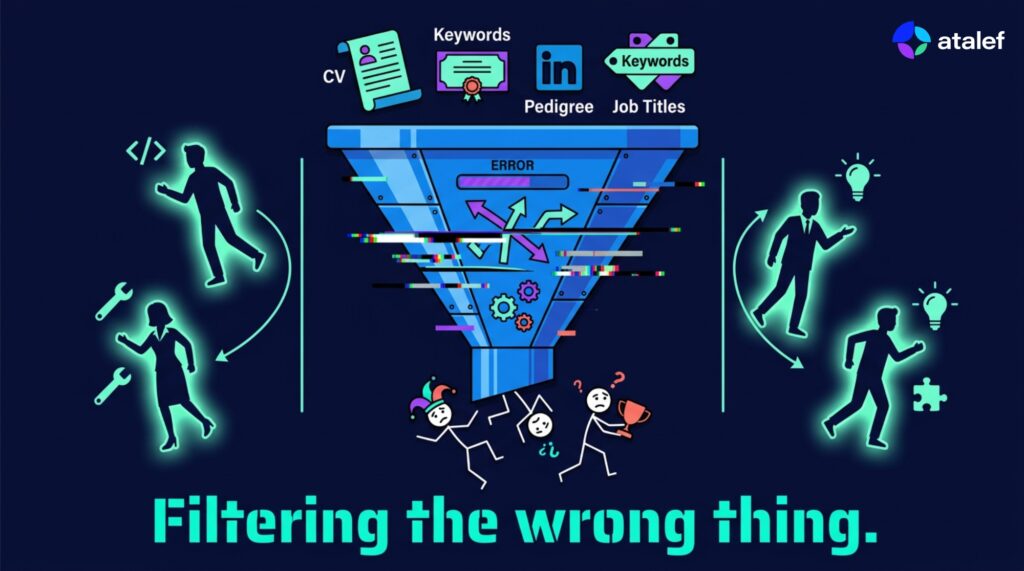
The system filters on proxies (resumes, credentials) instead of capability, so the wrong people enter the funnel. This results in what we think of as talent shortages. It’s not that the talent doesn’t exist; it’s that you can’t find the talent needle in the applicant haystack.
Alex Rashkovan, CEO of Atalef.ai explains:
“Most companies don’t have a tech talent shortage. They have a skills measurement and role-matching gap. Skills-based validation replaces CV assumptions with real data about what candidates can do and how they fit the role. At Atalef.ai, that’s exactly what we built DeepMatch for, our skills-validation and matching engine that compares candidates against role requirements. It gives hiring managers a defensible, skills-based reason for every shortlist decision.”
Instead of looking at skills, recruiters look at resumes. And for most jobs, the day-to-day tasks don’t involve resume writing, so resumes come in three categories:
- Written by an (expensive) professional resume writer who will make the resume sound great, but that reflects the paid writer’s talents more than the candidate’s
- Written by AI tools to optimize for keywords in a poorly written job description
- Terrible
There are people out there who can fill your vacant position, but they won’t make it past the screeners (human or AI) because their resumes don’t match what you’re looking for. Maybe they don’t have the right degree, didn’t work for the right company, or use clunky language to describe their knowledge, skills, and abilities.
The better way to fill technical roles is with skills matching, rather than keyword matching. When skills tests are available, you can even get candidates who wouldn’t meet the “on paper” qualifications but go ahead and take and pass the test with flying colors.
Knowing what people can actually do, rather than what they talk about doing, is the difference between a good new hire and a new hire who will struggle in the position.
The problem isn’t that candidates are lying or that hiring managers are unrealistic. It’s that both sides are working with incomplete signals. If you can create a skill evaluation that really works, you’ll find your talent shortage shrinking and your early-stage retention increasing. While hiring managers and candidates may still lean toward exaggerations, a solid test gets you to the truth.